- Home
- About Us
- Products
- News
- Application
- Service
- Blog
- Contact Us
Leave Your Message
-
Phone
-
E-mail
-
Whatsapp
-
Whatsapp

Global Wire Harness sourcing can look straightforward until drawings, samples, and production parts fail to match. A connector may fit on paper but clash with a vehicle bracket. A cable’s insulation may suit the factory floor yet struggle in heat, vibration, or repeated bending. Small details matter. So do clear records.
For this guide, composite sourcing specialist Elena Park expresses a practical principle: “A reliable Wire Harness begins with a clear specification, then earns trust through consistent evidence.” This is an editorially created quote, not a claim about a recorded interview. Buyers can apply its idea by checking conductor size, materials, connector details, labeling, test plans, and revision control. Ask how samples are approved and how changes are documented. Get the answers in writing.
The ten tips ahead help global buyers compare suppliers with more than unit price in mind. They cover drawings, prototypes, production capacity, quality checks, packaging, lead times, and communication. Request a sample harness with the same labels and protective wrapping planned for shipment. Inspect its routing, branch lengths, and connector locks. Then compare the documentation against the physical part. No checklist catches everything. Buyers can still overlook a detail, especially when specifications change mid-project. That is worth admitting. A careful review, direct questions, and a realistic supplier assessment can reduce avoidable surprises before orders scale.
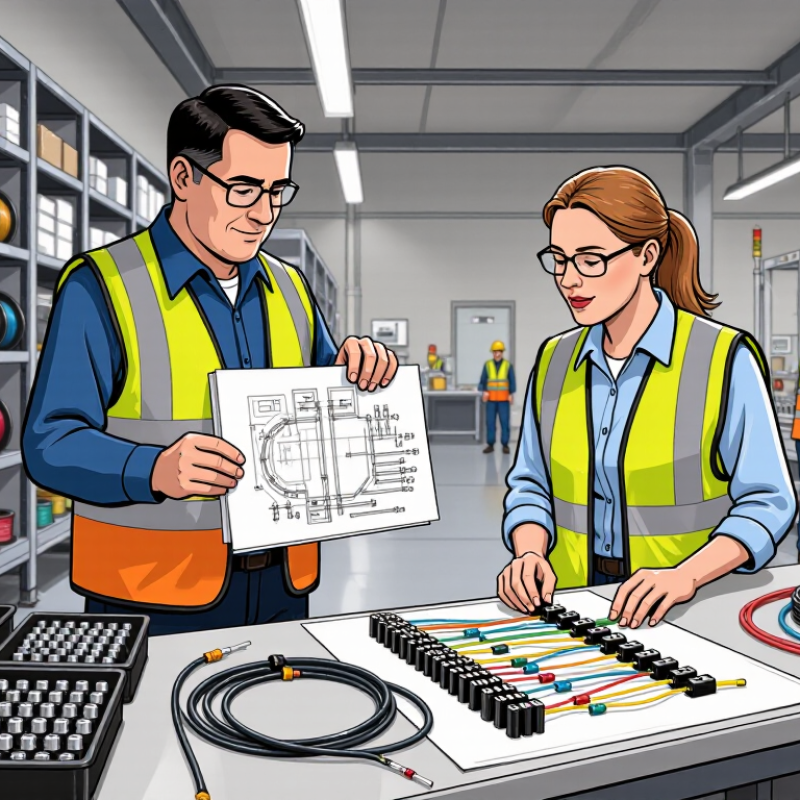
For global buyers, voltage and temperature are separate design checks. ISO 6722-1 covers single-core road-vehicle cables in 60 V and 600 V classes. Match the class to the circuit’s rated voltage, then confirm the exact cable construction and test requirements against the applicable standard edition. Do not treat “600 V” as a general guarantee for every harness condition. Connectors, seals, splices, and routing also affect system performance.
Temperature needs equal attention. Check the cable’s specified temperature class against both continuous heat and short-term exposure near engines, batteries, or exhaust components. A wire may sit beside a hot metal bracket, where local temperature differs from the vehicle’s cabin reading. Ask suppliers for the relevant test evidence and temperature limits; ambient-temperature claims alone are thin evidence. The International Energy Agency’s Global EV Outlook 2024 reported that electric-car sales were expected to exceed 17 million in 2024, or more than one-fifth of global car sales. That growth makes clear voltage and thermal specifications increasingly important, especially in mixed-voltage vehicle designs. One detail buyers sometimes miss: voltage class does not establish temperature suitability. I would verify both on the same datasheet, then check the actual installation path. Small oversight, costly rework.
| # | Buying Dimension | What to Define in the RFQ | What to Verify |
|---|---|---|---|
| 1 | Voltage category | State the circuit’s nominal and maximum operating voltage, including transient conditions, and identify whether the cable is intended for a 60 V or 600 V application. | Confirm the applicable ISO 6722 edition and cable specification. Do not assume that a 600 V cable category by itself makes a complete harness suitable for a higher-voltage vehicle system. |
| 2 | Temperature range | Specify the minimum and maximum temperatures at the cable location, expected duration of heat exposure, and any cold-flex requirements. | Check the selected cable’s declared temperature class and supporting test data. Consider nearby heat sources, bundling, airflow, and installation conditions. |
| 3 | Applicable standards | List required cable, component, harness, vehicle, and market-specific standards separately, with their editions where known. | ISO 6722 addresses road-vehicle single-core cables within its defined scope; it is not, by itself, a complete wire-harness design or vehicle-system approval. |
| 4 | Conductor size and current | Provide conductor cross-sectional area, expected continuous and peak current, duty cycle, allowable voltage drop, and fuse or circuit-protection details. | Review ampacity and voltage-drop calculations for the actual routing and ambient conditions. Conductor size alone does not establish safe current capacity. |
| 5 | Insulation and environment | Describe exposure to fluids, moisture, dust, abrasion, vibration, chemicals, and any required shielding or protective conduit. | Request material and compatibility information for the intended environment, plus evidence for any stated ingress or chemical-resistance requirements. |
| 6 | Routing and mechanical fit | Supply harness drawings, connector locations, branch lengths, bend constraints, mounting points, and available installation space. | Check minimum bend radius, clearance, strain relief, abrasion protection, and whether the harness can be installed without excessive tension. |
| 7 | Connectors and terminals | Specify connector interfaces, terminal types, cavity assignments, wire seals, locking features, and mating-component requirements. | Confirm terminal-to-wire compatibility, crimp requirements, retention, and applicable inspection or pull-test criteria. |
| 8 | Testing and acceptance | Define required electrical and mechanical checks, sample size, test conditions, acceptance limits, and documentation format. | Agree on continuity, insulation-resistance, dielectric, dimensional, and other application-required tests before production approval. |
| 9 | Traceability and change control | Request lot identification, material records, revision control, and a process for notifying buyers of design or material changes. | Ensure certificates and test reports identify the relevant part, revision, production lot, and applicable standard or specification. |
| 10 | Global delivery and compliance | Specify destination markets, labeling languages, packaging, shipping terms, required declarations, and delivery documentation. | Check import and market-specific requirements with the responsible compliance team; do not treat a cable standard as proof of full product compliance. |
Scope note: ISO 6722 is associated with 60 V and 600 V single-core road-vehicle cables. Confirm the current applicable edition, its precise scope, and the cable supplier’s declared ratings for the specific project.