2026 Top Tactile Switch Types for Enhanced User Experience and Performance?
In the rapidly evolving landscape of electronic devices, tactile switches play a crucial role in enhancing user experience. According to a recent market analysis by Global Market Insights, the tactile switch market is expected to reach USD 2.5 billion by 2026, driven by rising consumer demand for intuitive interfaces. Industry expert Dr. Emily Chen states, “Tactile switches not only improve interaction but also boost overall product performance.”
These switches provide tactile feedback, ensuring users feel a distinct response when activating devices. This feedback is essential for applications ranging from automotive controls to consumer electronics. Despite their popularity, some designs still face challenges in durability and consistency. Striking the right balance between sensitivity and longevity remains a topic of ongoing research.
As technology advances, the need for innovative tactile switch types continues to rise. Enhanced designs could significantly impact usability and satisfaction. However, manufacturers must address the shortcomings in current models. Building a better tactile switch involves understanding user needs and integrating advanced materials. The future of tactile switches holds promise, but innovation and reliability must remain a priority.
Overview of Tactile Switches and Their Importance in User Experience
Tactile switches are vital for user interaction. Their design creates a unique feedback loop that enhances the overall experience. When pressed, they provide a noticeable tactile response. This helps users confirm their actions without needing a visual cue. The distinct feel is crucial in applications like gaming and typing, where precision matters.
Different types of tactile switches serve unique purposes. Some may feel overly stiff, while others might not offer enough resistance. Designers must test various options to balance feel and function. Close attention to user feedback is essential in this process. Though a switch might seem perfect, it may require fine-tuning based on user preferences.
Moreover, the material used in tactile switches affects their lifespan and performance. Low-quality materials can lead to a quick degradation of the user experience. This often gets overlooked, but it’s a significant factor. Continuous assessment and redesign are necessary. Enhancing tactile switches is an ongoing journey, reflecting the dynamic nature of user expectations.
2026 Top Tactile Switch Types for Enhanced User Experience and Performance
| Switch Type |
Actuation Force (g) |
Travel Distance (mm) |
Feedback Type |
Durability (Cycles) |
| Standard Tactile Switch |
60 |
1.5 |
Tactile |
1,000,000 |
| Low Profile Tactile Switch |
50 |
1.0 |
Soft Tactile |
500,000 |
| Heavy Duty Tactile Switch |
80 |
2.0 |
Audible Click |
2,000,000 |
| Miniature Tactile Switch |
45 |
1.2 |
Tactile |
1,000,000 |
| Sealed Tactile Switch |
70 |
1.8 |
Tactile |
1,500,000 |
Key Features of Popular Tactile Switch Types for 2026
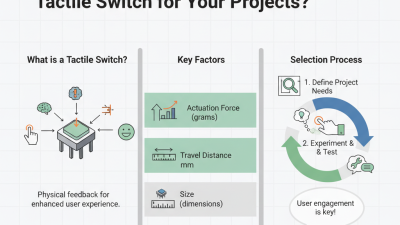
In 2026, tactile switches are evolving to enhance user experience and performance in numerous applications. Among the key features to look for are actuation force, travel distance, and durability. A lighter actuation force can improve responsiveness, making devices feel more agile. Conversely, a stronger force provides tactile feedback that assures the user they have activated the switch.
Travel distance is another critical aspect. Short travel distances can yield faster input responses, which is essential for gaming or rapid typing. However, some users prefer longer travel for a satisfying tactile feel. Durability remains paramount, as users expect switches to withstand millions of presses without failure. Manufacturers are exploring innovative materials to increase lifespan, yet some designs still fall short, leading to reliability concerns.
Additionally, the audible feedback from tactile switches contributes to user comfort. A distinct click can enhance the experience, but some may find it distracting. Balancing sound and feel is an ongoing challenge. Despite advancements, no single switch type fits all users. Preferences vary widely, and therefore, testing multiple options is vital to find the ideal tactile switch for diverse needs.
Comparative Analysis of Mechanical vs. Membrane Tactile Switches
The choice between mechanical and membrane tactile switches greatly affects user experience. Mechanical switches often provide a tactile response. Users can feel each keystroke distinctly. This feedback allows for greater typing accuracy. Data indicates that mechanical switches can achieve up to 50 million keystrokes. This durability makes them ideal for heavy users.
Membrane switches tend to be quieter. They work well in environments where noise reduction is essential. However, the tactile feedback may be less pronounced. This can lead to a less satisfying experience for some users. Reports show that while they are cost-effective, they may need to be replaced more frequently. Their lifespan can average around 5 million keystrokes.
User preference plays a crucial role. Some users enjoy the clicky feedback of mechanical switches. Others prefer the sleek design of membrane options. This highlights the need for thoughtful selection. Balancing tactile response and longevity is essential for optimal performance. Different applications may require different switch types. Understanding these nuances is paramount for designers and developers.
2026 Comparative Analysis of Mechanical vs. Membrane Tactile Switches
This chart represents a comparative analysis of key performance metrics for mechanical and membrane tactile switches in 2026. Mechanical switches are known for faster response times, higher durability, and better tactile feedback, while membrane switches are more cost-effective but fall short in the other metrics.
Innovative Design Trends in Tactile Switch Technologies for Enhanced Performance
In the realm of tactile switch technologies, innovative design trends are reshaping the user experience. Today's consumers seek switches that not only feel satisfying but also enhance performance. Designers are focusing on materials that provide a unique tactile feedback. Options like silicone rubber and specialized composites are becoming popular. These materials can improve durability and responsiveness.
Design is shifting towards smaller, more compact switches. This trend supports sleek devices while maintaining user comfort. Engineers are exploring new mechanisms to achieve better actuation. Implementing spring-based designs can increase life cycles and ensure reliable performance. These innovations promise greater engagement for users.
Tips: Consider switch placement carefully. Ergonomics play a vital role in user experience. Testing various designs can reveal which configurations work best. Emphasizing feedback can lead to better usability. Involve end-users in the design process for more insights. This iterative approach fosters creativity and enhances overall product effectiveness.
Future Directions for Tactile Switch Development and User Interaction
The tactile switch industry is evolving rapidly. Users demand more responsive and durable switches that enhance their experience. As designers experiment with materials and mechanics, new types emerge to meet these needs. Future developments may focus on haptics, providing rich feedback to users. This could create an immersive user experience across devices.
Research shows that customizability is key for user satisfaction. A switch may feel tactile yet soft for some tasks, while others may prefer a firm response. Understanding personal preferences is essential. There’s a balance between standard offerings and user-driven designs. Reaching this balance is a challenge that requires ongoing dialogue between manufacturers and users.
Moreover, sustainability is becoming important in product development. Users are more environmentally conscious. They seek switches made from recyclable or biodegradable materials. This reflects a larger trend toward responsible consumption. Tactile switch designers must consider these factors as they innovate. It's a complex landscape, where user interaction is at the forefront. Progress will come from community feedback and iterative designs.